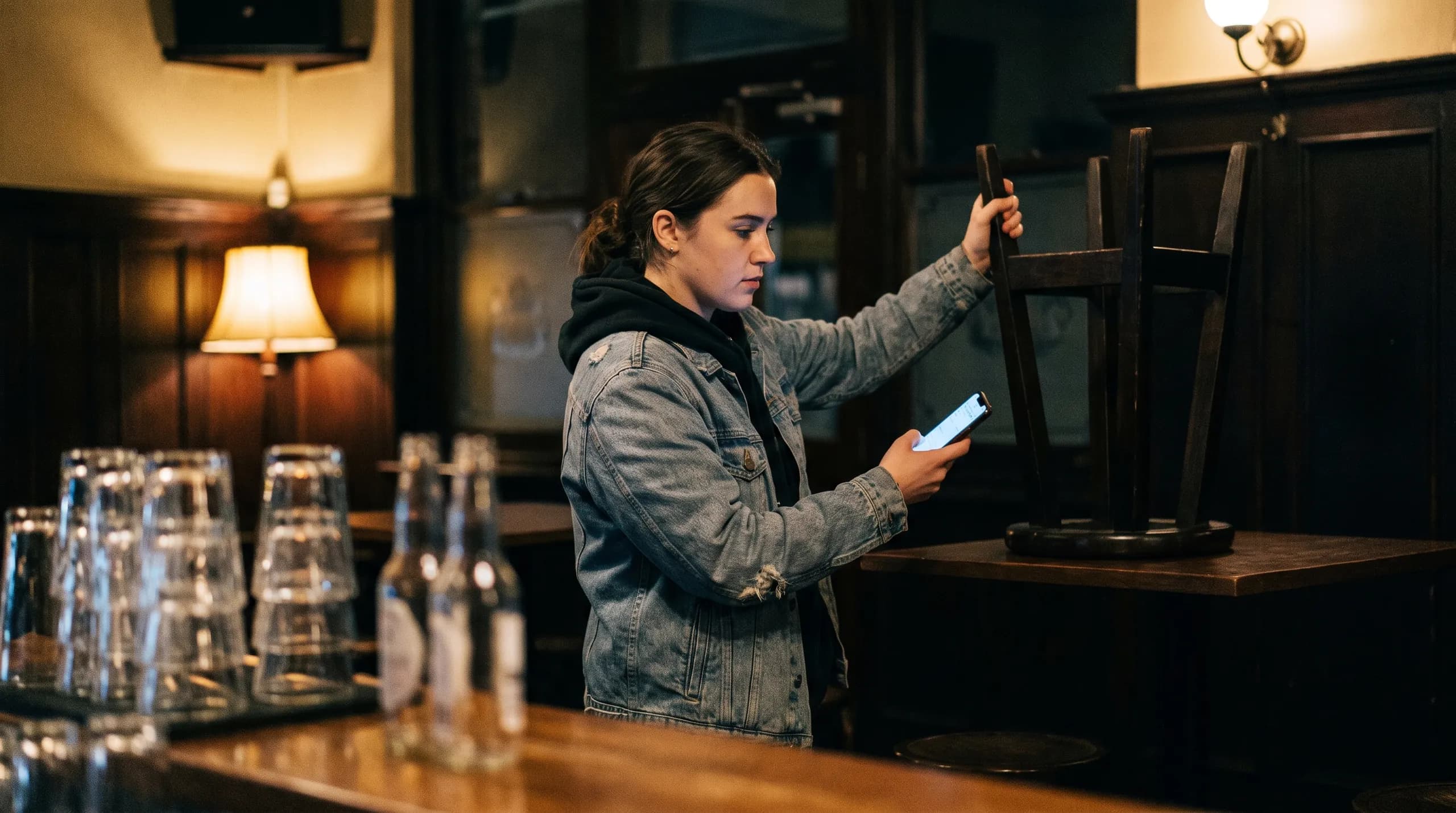
Your availability is the setting that decides how many shifts you get offered

Most casuals fill in their availability once, in week one, and never touch it again. Here's what the Hospitality Award actually lets a venue do with it, the protection part-timers have that casuals don't, and the weekly maths on widening your window from weekends only to any evening.
You filled it in once, probably in week one, probably on your phone in the car park. Saturday and Sunday ticked, everything else blank. That single setting now does more to your income than anything you do behind the bar.
Widening it from weekends only to weekends plus any weeknight evening is worth $429.80 a week to a casual Level 2 in a Sydney pub, and it costs you $4.10 an hour. Both halves of that are true, and almost nobody tells you either one.
Search this question and you'll get compliance articles for employers, an availability policy template for managers, and a clause bank for lawyers. Nothing written for the person whose hours are actually at stake. So here's the worker's half, with the award clause numbers so you can check every line of it.
Short version: if you're casual, your stated availability is not a legal boundary. Nothing in the Hospitality Award stops a venue offering you a Tuesday you never said you could work, and nothing makes you take it. If you're part-time, it is a boundary: clause 10.7(a) of MA000009 says you must not be rostered to work any hours outside the employee's availability. This is general information, not legal advice. Rates are MA000009 minimums applying from the first full pay period on or after 1 July 2026.
Can they roster you outside your availability?
If you're a casual, there's no rule either way, because the award never mentions your availability at all. What it does is leave you free to decline. The Fair Work Act's casual test turns on there being no firm advance commitment to ongoing work, and one of the factors the Ombudsman lists is whether the employee can accept or reject work (and whether this is happening).
The flip side is the part employer-side pages skip. Clause 15.5 of the Hospitality Award opens by saying the rostering provisions that follow apply to full-time and part-time employees, so the seven days' notice rule for changing a published roster isn't yours. A venue can also just stop offering, which is the real risk and the subject of our piece on what refusing a shift actually costs a casual.
If you're part-time, the answer flips completely
This is the single most useful thing on this page and it's buried in clause 10 of the award. When you're engaged part-time, your employer must agree with you in writing on your guaranteed hours and on the days and times you're available to work them. Clause 10.7(a) then says you must not be rostered outside that window. Not "should not". Must not.
Changing it has a process too. If there's a genuine and ongoing change in your personal circumstances, you can alter the times you're available by giving 14 days' written notice. If the employer can't reasonably accommodate it, your guaranteed hours stop applying and the two of you have to agree a new set. And after 12 months of regularly working more than your guaranteed hours, you can ask in writing to have them increased, which can only be refused on reasonable business grounds, in writing.
| The question | If you're casual | If you're part-time |
|---|---|---|
| Is your availability binding on the venue? | No. The award says nothing about casual availability | Yes. Agreed in writing at engagement, clause 10.4(b) |
| Can they roster you outside it? | They can offer you anything. Nothing makes you accept | No. Clause 10.7(a) prohibits it outright |
| How do you change it? | Tell them. No form, no notice period | 14 days' written notice, for a genuine and ongoing change in your circumstances (10.11) |
| Notice before a published roster changes | None. Clause 15.5 covers full-time and part-time only | 7 days, or by mutual agreement (15.5(d)) |
| Guaranteed hours | None | Yes, and changing them needs your written consent (10.5) |
One protection does reach across. The award's consultation clause applies whenever an employer proposes to change the regular roster or ordinary hours of work of an employee, other than an employee whose working hours are irregular, sporadic or unpredictable. If you're a casual with a settled weekly pattern, that exclusion doesn't obviously describe you, and they're meant to tell you, hear your view and consider it before the pattern changes.
Availability runs before anyone looks at your name
Here's how a roster actually gets built on a Wednesday afternoon. The manager opens the week, filters to who's marked available for each gap, and picks from whoever's left. Being reliable, quick and good with regulars decides who gets picked inside that filter. Your availability decides whether you're in it at all.
Which makes weekends-only the most crowded setting in hospitality. There were 484,000 casual employees in accommodation and food services in August 2025 and 58% of everyone in the industry is a casual, the highest share of any Australian industry. Every one of them can work Saturday night. Far fewer can do a Tuesday close, and Tuesday close is the shift your manager is actually stuck on.
What each window is worth an hour
Before you widen anything, know what you're widening into. These are casual Level 2 rates, the grade most bar and floor staff sit on, from the first full pay period on or after 1 July 2026.
| The window you tick | Casual Level 2 rate | How the award gets there |
|---|---|---|
| Monday to Friday, 7am to 7pm | $33.85 | 125% of the ordinary hourly rate |
| Monday to Friday, 7pm to midnight | $36.80 | 125% plus $2.95 an hour |
| Monday to Friday, midnight to 7am | $38.27 | 125% plus $4.42 an hour |
| Saturday, any hour | $40.62 | 150% |
| Sunday, any hour | $47.39 | 175% |
| Public holiday | $67.70 | 250% |
Note the shape of the evening loading: it's a flat $2.95 an hour, not a percentage. So a weeknight evening pays $3.82 an hour less than a Saturday and $10.59 less than a Sunday, whatever your level. That gap is the entire cost of widening, and it's smaller than most people assume. Your award level moves every one of these numbers, so it's worth checking you're graded right first.
Three availability settings, same person, same venue
One casual Level 2 at one Sydney pub, running the same two weekend shifts in every scenario: Saturday 5pm to 11pm and Sunday 11am to 5pm. The only thing that changes is which other boxes are ticked. Weeknight shifts are 5pm to 11pm, so two hours at the day rate and four at the evening rate.
| Availability setting | Shifts a week | Hours | Weekly pay | Effective hourly | Over 12 weeks |
|---|---|---|---|---|---|
| Saturday and Sunday only | 2 | 12 | $528.06 | $44.01 | $6,336.72 |
| Plus any evening, Monday to Thursday | 4 | 24 | $957.86 | $39.91 | $11,494.32 |
| Plus weekday daytimes | 5 | 30 | $1,160.96 | $38.70 | $13,931.52 |
Read the last two columns together, because that's the whole decision. Going from weekends-only to weekends-plus-evenings raises your weekly pay 81% and drops your effective hourly rate 9%. Open the weekdays as well and you're up 120% on the week while your average hour is worth 12% less. Nobody is underpaying you in any of those rows. You're just buying volume with rate.
Four extra ticks in a roster app moved this casual from $6,337 a term to $11,494. No conversation, no raise, no new job.
Two honest caveats. Those extra shifts only exist if the venue actually has the trade, so widening at a quiet cafe changes nothing. And the shifts you pick up are the ones nobody else wanted, which is exactly why they're available, and exactly why you get them.
How to write availability that gets you rostered
- Give times, not days. "Available Tuesdays" is useless to someone filling a 5pm to close. "Mon to Thu from 4pm, Sat all day, Sun till 6pm" can be rostered without a single text back.
- Add one hard shift on purpose. Sunday close, Monday lunch, the 6am breakfast run. Pick the one you can genuinely do every week, and you become the name that solves a recurring problem rather than one of forty who can do Saturday.
- Send it unprompted, once a month. Managers roster the availability they can see. A short message on the first of the month beats being asked, and it resets whatever they had written down from March.
- Say what you're not available for, and why, in one line. "Not Wednesdays, I've got class" reads as a schedule. Silence reads as unreliable.
- Widen for a block, not forever. "Open Monday to Thursday evenings until mid-November" is easy to say yes to and easy to take back. An open-ended widening is much harder to walk in from.
- If you qualify, put it in writing formally. Casuals employed on a regular and systematic basis for 12 months with a reasonable expectation of continuing work can make a flexible working request in listed circumstances, including caring, disability, pregnancy, being 55 or over, or experiencing family and domestic violence. That gets you a written answer, refusable only on reasonable business grounds.
Widening isn't the same as being on call. A casual must be engaged and paid for at least 2 consecutive hours every time they're required to attend, so nobody can call you in for a 45 minute rush. You're capped at 12 hours a day or shift and 38 hours a week before overtime, and those caps sit with each employer separately, which matters if you're working across two venues. And an open availability window doesn't cancel your right to disconnect, in force since 26 August 2024, or 26 August 2025 at a small business.
Where Shiftly comes in
The reason widening your availability feels risky is that it's all going to one venue, whose trade you can't control and whose roster you can't see. Shiftly changes what's on the other end of the setting. It's free workforce management for Australian venues with an on-demand staffing network built in, so when a venue is short the shift goes out to workers nearby instead of into a group chat at 4pm. For you that means a Tuesday you've opened up gets matched against every venue near you rather than one, you see the venue, the hours and the pay before you accept, and you get paid fast once the shift is done. Find shifts on Shiftly.
Frequently asked questions
Can my employer roster me when I said I'm not available?
If you're casual, they can put you on a roster and ask, and nothing in the Hospitality Award prevents that, because the award never deals with casual availability. What it doesn't do is oblige you to work it. The casual test in the Fair Work Act turns partly on whether you can accept or reject work, so a casual who can't decline may not legally be a casual at all. If you're part-time it's different: clause 10.7(a) of MA000009 says a part-time employee must not be rostered to work any hours outside their agreed availability, full stop.
How much notice do I have to give to change my availability?
As a casual, none. There's no form and no notice period, so it's whatever your venue's own policy asks for, and a message with dates is usually the end of it. As a part-time employee you can alter the times you're available by giving 14 days' written notice, but only where there's a genuine and ongoing change in your personal circumstances. If your employer can't reasonably accommodate the change, your guaranteed hours cease to apply and you both have to agree a new set.
Will saying I'm available more actually get me more shifts?
Only where the venue has unfilled gaps, which is why the hours you open matter more than the number of them. Weekend nights are the window every casual has already ticked, so adding more of them changes little. Weeknight evenings, Sunday closes and early mornings are where rosters genuinely run short, and on the maths above, four weeknight evening ticks took one casual Level 2 from $528.06 to $957.86 a week. The trade is real: those hours pay $36.80 against $47.39 on a Sunday, so your average hourly rate falls while your total pay rises.
Can they cut my shifts because I narrowed my availability?
Yes, and lawfully, because narrower availability means fewer shifts you can be rostered into. That's a rostering consequence, not a punishment, and there's no entitlement to be offered work as a casual. It becomes a different matter if the hours drop for a protected reason rather than a practical one, such as taking carer's leave or using your right to disconnect. If you're a casual with a settled weekly pattern, the award's consultation clause also says your employer should discuss a change to that pattern with you first. Our guide to getting more shifts as a casual in Sydney covers rebuilding hours from there.

Co-founder of Shiftly. Milan works with hospitality businesses across Australia to make rostering, timesheets and award-based pay radically simpler.