How many staff does a 100-guest function need? Bar and floor ratios, and what the crew costs on a Saturday at award rates
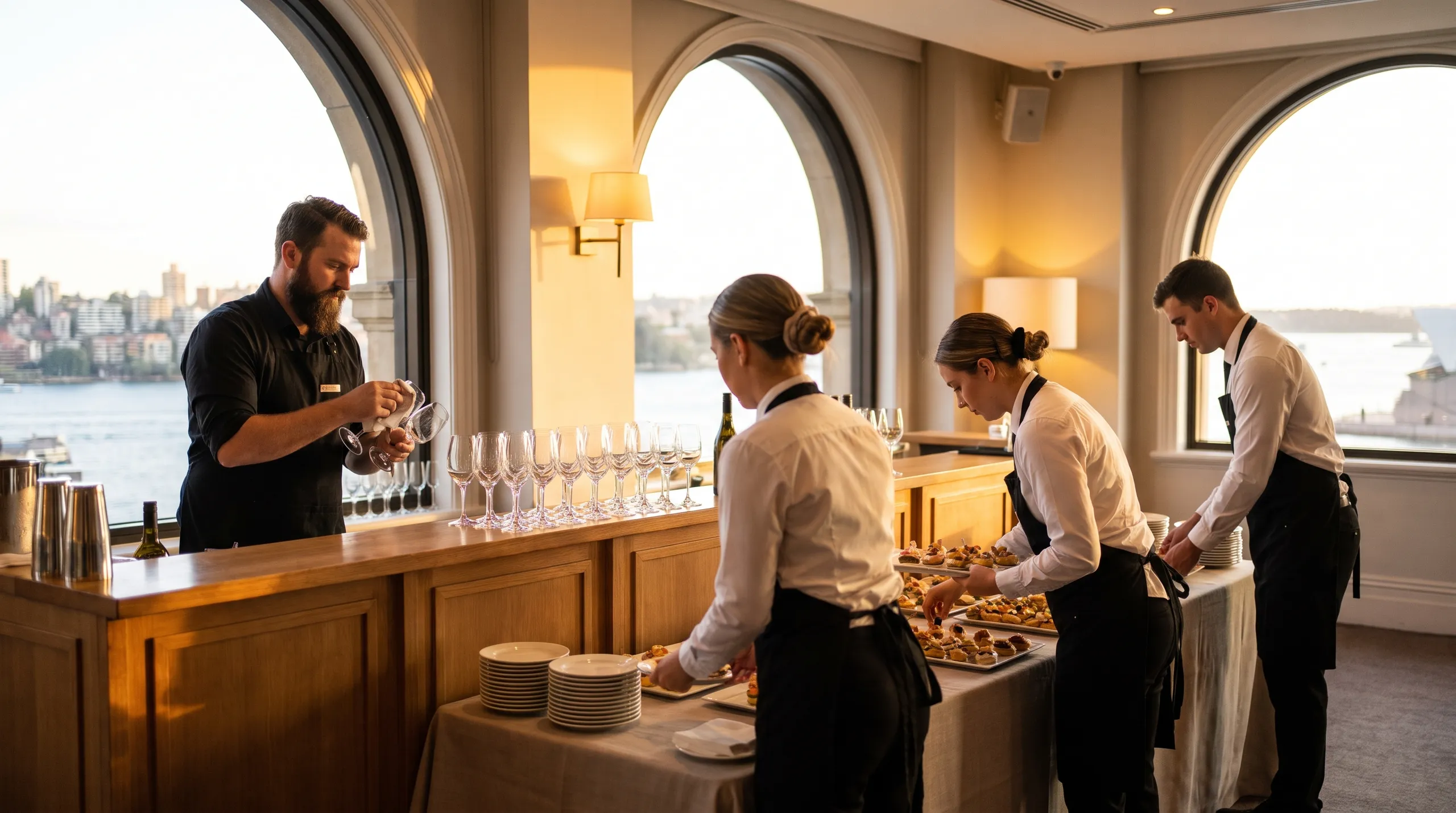
A stand-up function for 100 needs about six on bar and floor, and a plated dinner ten or more. Here are the ratios by format, and a seven-person crew costed at Hospitality Award casual rates: $1,547.24 on a Friday, $1,737.79 on a Saturday.
A stand-up function for 100 guests on beer and wine needs about six people on bar and floor, and a seated, plated dinner for the same 100 needs ten or more. On a Saturday in Sydney that six-person crew, plus one arrival host, costs $1,737.79 in casual wages and super under the Hospitality Award. Move the same function to a Friday and it's $1,547.24.
The ratios that rank for this search come from US event blogs, which quote one bartender per 50 to 100 guests and never put an Australian dollar figure next to it. Here's the local version: a ratio table by format, then the crew costed at MA000009 casual rates, set-up and pack-down included.
Quick answer: for 100 guests, plan one floor staff member per 30 to 40 guests for passed canapés, or one per 10 to 12 for a plated dinner. On the bar, plan one bartender per 50 to 75 guests for beer and wine, and one per 30 to 40 for cocktails. Add one senior person to run the room. These are working rules of thumb, not award rules. Rates below are from 1 July 2026, and this is general information, not financial or legal advice.
Staff to guest ratios for a 100-guest function
The format decides the headcount far more than the guest count does. A plated dinner puts a waiter on every table at once, while a canapé function lets three people work the whole room in loops.
| Format, 100 guests | Floor | Bar | Running the room | Bar and floor crew |
|---|---|---|---|---|
| Stand-up canapé, beer and wine | 3 (1 per 30 to 40) | 2 (1 per 50 to 75) | 1 | 6 |
| Stand-up canapé, cocktails | 3 (1 per 30 to 40) | 3 (1 per 30 to 40) | 1 | 7 |
| Seated, shared plates or buffet | 4 to 5 (1 per 20 to 25) | 2 | 1 | 7 to 8 |
| Seated, plated and served | 8 to 10 (about 1 per table) | 1 to 2 (waiters pour wine at the table) | 1 | 10 to 13 |
The US figure of one bartender per 100 only holds for a slow, simple bar. Australian function bars usually run on a tab or drink tickets, so everyone orders in the same 20 minutes after doors open. Size the bar for that first rush, not for the average across the night.
What pushes the ratio up
- A cocktail list. A built cocktail takes three or four times as long as pouring a beer, which is why the bar ratio nearly halves.
- One bar for a big room. If guests walk 30 metres to the bar, you need more floor staff carrying trays out to them.
- Speeches and a hard finish. Clearing for speeches, then the 10:30pm last-drinks rush, both need hands at the same moment.
- Glassware instead of plastic. Someone has to collect, wash and restock it, so add a glassie for anything over 80 guests.
- A staggered arrival. If guests arrive over an hour, a door and cloak host takes the pressure off the bar and the function lead.
What the crew costs: Friday against Saturday
Take the first row: a stand-up canapé function for 100, beer and wine, 6pm to 11pm. The floor and bar crew and the function lead work 5:30pm to 11:30pm, so 30 minutes each side for set-up and pack-down. A door and cloak host covers the arrival rush. Bar and floor staff who serve and mix drinks are Level 2 (food and beverage attendant grade 2) under the award's classifications, and the lead is Level 3.
The casual Level 2 rate is $33.85 an hour on a weekday and $40.62 on a Saturday. On Monday to Friday, every hour or part of an hour worked between 7pm and midnight adds $2.95. So the half-hour from 11pm to 11:30pm attracts the full $2.95, and Friday pays five lots of it. Saturday has no evening allowance, because the 150% Saturday rate already applies all day.
| Role | Heads | Shift | Friday wages | Saturday wages |
|---|---|---|---|---|
| Floor, Level 2 casual | 3 | 5:30pm to 11:30pm | $653.55 | $731.16 |
| Bar, Level 2 casual | 2 | 5:30pm to 11:30pm | $435.70 | $487.44 |
| Function lead, Level 3 casual | 1 | 5:30pm to 11:30pm | $224.51 | $251.76 |
| Door and cloak host, Level 2 casual | 1 | 5pm to 7pm (the 2-hour minimum) | $67.70 | $81.24 |
| Wages, 38 paid hours | 7 | $1,381.46 | $1,551.60 | |
| Super at 12% | $165.78 | $186.19 | ||
| Total | $1,547.24 | $1,737.79 | ||
| Per guest | $15.47 | $17.38 |
Per head, a 6-hour Level 2 shift is $217.85 on the Friday ($203.10 plus $14.75 in evening allowance) and $243.72 on the Saturday. With super, each extra Level 2 head adds $243.99 to a Friday and $272.97 to a Saturday. Use that number to scale the table: the plated dinner in the last row of the ratio table needs four to seven more heads than this crew, or $1,091.88 to $1,910.79 more on a Saturday.
This is wages plus super only. Workers compensation and, for larger venues, NSW payroll tax sit on top. The December staffing plan shows the fully loaded version for an 80-guest function.
The three hidden lines in a function roster
Set-up and pack-down are paid at the same rate
Seven of the 38 paid hours above happen with no guests in the room: half an hour each side for six people, plus the host's first hour. On the Saturday that's $285.68 in wages before super. Build it into the package price per head, because it doesn't shrink when the guest count does.
The 2-hour minimum turns one hour of need into two
The award says a casual must be engaged and paid for at least 2 consecutive hours each time they attend work. You only need the door host for the 6pm arrivals, but you pay for two hours either way. So give them the first hour of set-up, and get value from the hour you're already paying for.
A sixth hour is the line, not a seventh
Under the award's breaks table, a shift of more than 6 hours and up to 8 comes with an unpaid meal break of at least 30 minutes, taken after the first 2 hours and within the first 6. Stretch this crew to a 7-hour call and each person needs a 30-minute unpaid break, so you get 6.5 paid hours and someone off the floor mid-service. Our post on breaks on a hospitality shift covers what goes wrong when a break gets skipped.
Let a Saturday pack-down run past midnight and those minutes are Sunday time, at $47.39 an hour for a Level 2 casual.
Where an on-demand pool covers the extra heads
Not every head on a function needs to know your venue. The function lead and at least one bartender should be your own people, because they know the POS, the tab rules and the room. The rest of the crew (floor, glassies, the door host) do work that any experienced casual picks up in a 10-minute briefing.
- Roster your core crew first: the lead, one bartender, and anyone who touches the POS or the run sheet.
- Work out the gap with the ratio table, using the confirmed guest count, not the deposit count.
- Post the gap as open shifts at least a week out, and brief newcomers like a first shift: where the glass wash is, who calls last drinks, how the tab works.
- Keep one name on standby for the night, because one staff cancellation on the day leaves the room short, and the cost of a no-show is highest when the room is full.
Staff the function from the same roster
Shiftly is the roster that fills itself: free rostering and award-aware timesheets for venues, with an on-demand staffing network built into the same roster. Build the function crew on the roster, and the award interpretation helps you estimate what each shift costs at the right level and penalty rate before you confirm the quote. Shiftly On-Demand is coming soon, starting in Sydney. When it opens, the extra floor and bar heads go out as open shifts to nearby hospitality workers, who see the venue, the hours and the pay before they accept. Get started with Shiftly.
Frequently asked questions
How many bartenders do you need per 100 guests?
Plan two bartenders for 100 guests on beer and wine (one per 50 to 75), and three for a cocktail list (one per 30 to 40). If the bar runs on a tab or drink tickets, size it for the rush in the first 20 minutes after doors open, not for the average across the night.
How many waiters per guest does a seated dinner need?
A plated, served dinner needs about one waiter per 10 to 12 guests, which works out to roughly one per table, so eight to ten for 100 guests. Shared plates or a buffet need far fewer, about one per 20 to 25 guests.
Do casuals get paid for set-up and pack-down?
Yes. Rostered set-up and pack-down time is time worked, paid at whatever rate applies at that hour, and each casual engagement must be at least 2 consecutive hours under clause 11.3 of the Hospitality Award. In the Saturday example, set-up and pack-down account for 7 of 38 paid hours.
How much more does a Saturday function cost than a Friday one?
For the seven-person crew above, $190.55 more, or about 12%. A casual Level 2 earns $40.62 an hour on a Saturday against $33.85 on a weekday, but Friday claws some of that back through the $2.95 evening allowance for each hour or part of an hour after 7pm.

Co-founder of Shiftly. Milan works with hospitality businesses across Australia to make rostering, timesheets and award-based pay radically simpler.