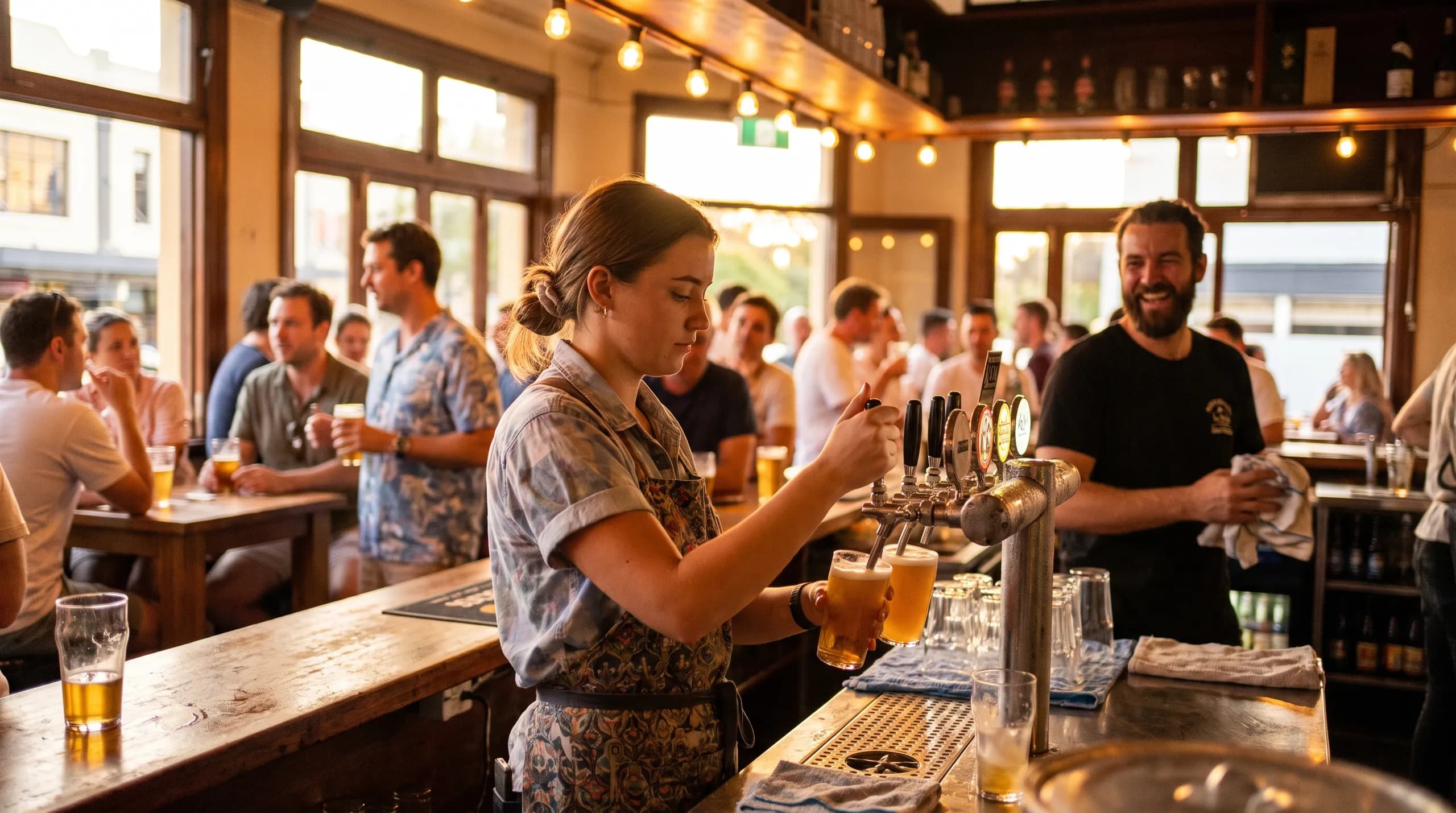
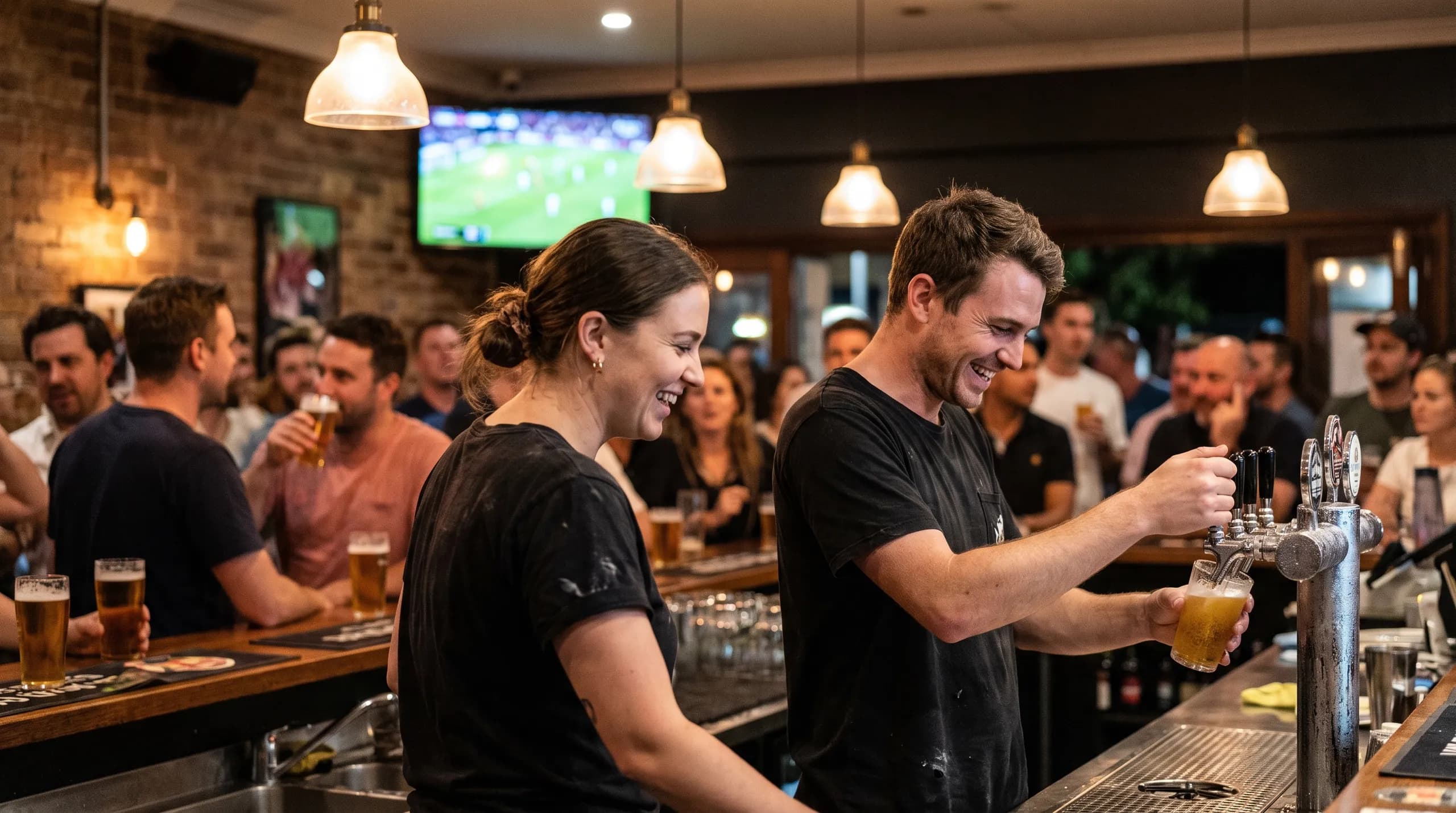
Told to wear all black? Why the venue won't pay for it and the ATO won't let you claim it

An all-black dress code falls through two gaps at once: the Hospitality Award excludes black and white attire from the clothing a venue must pay for, and the ATO uses black pants on hospitality staff as its example of clothing you can't claim. Here's a costed starter kit showing who covers what, and what you can still claim by 31 October.
"All black, non-slip shoes, see you Friday." That's the whole dress code at a lot of Sydney bars, and its cost lands on you twice. The Hospitality Award says the venue doesn't have to pay for black and white attire, and the ATO uses black pants on hospitality staff as its own example of clothing you can't claim.
The tax-time lists that rank for this repeat the ATO half. None we found puts it next to the award half, which is what tells you the venue isn't covering it either. Here's what each rulebook says, a costed starter kit showing who pays for every piece, and what's still worth claiming before your return is due on 31 October.
Short answer: you can't claim plain black work clothes, or washing them, even when your venue makes them compulsory, and under clause 26.6 of the Hospitality Industry (General) Award (MA000009) the venue doesn't have to pay for them either. You can claim protective gear like non-slip shoes and aprons, a compulsory logo uniform you paid for, washing that uniform at $1 a load, and renewing (not getting) your RSA. A venue that requires logo items or an apron has to supply them or pay you back. This is general information, not tax, financial or legal advice.
The ATO's example of clothing you can't claim is your outfit
The ATO's guide for hospitality workers defines conventional clothing as everyday clothing worn regardless of occupation, "for example, black pants and white business shirts worn by hospitality industry employees". You can't claim it "even if your employer requires you to wear it and you only wear these items of clothing at work".
Its worked examples could be your last shift. Pablo, a barista, must wear a logo shirt, black pants and closed black shoes, and buys all three. He can claim the shirts, not the pants or shoes, because a required colour doesn't make them distinctive. Cassidy, a waitress in a white shirt and black pants, can't claim washing them even if she does it herself: washing is only deductible when the clothing is.
The Hospitality Award carves black out too
Clause 26.6 makes the venue supply or pay you back for special clothing, meaning anything it requires you to wear, protective clothing included. Then the definition takes black off the table: special clothing "does not include shoes, hosiery, socks and any black and white attire (other than a dinner suit or evening dress) that is not part of a uniform or formal clothing".
Wash special clothing yourself and clause 26.6(c) says the venue pays an agreed weekly laundry allowance, or the actual cost if you haven't agreed one. Catering and motel staff get set amounts instead, current from the first full pay period on or after 1 July 2026: $2.10 per uniform for casuals in catering, and $2.46 per uniform (up to $7.65 a week) in motels. The Restaurant Award repeats the black and white carve-out word for word at clause 21.5(a), and the Clubs Award has it at 19.3(c)(v).
Two rulebooks, one pair of black pants, and neither of them is paying for it.
Two exceptions matter. A dinner suit or evening dress the venue requires for a function is on the venue. And the carve-out only covers black and white that is not part of a uniform, so black pieces in a defined, issued uniform are a greyer case worth raising. Like the late transport clause, none of this makes the summaries. You have to read the clause.
A costed starter kit: who pays for each piece
Here's the first year of an all-black dress code for a casual bartender at a Sydney pub on the Hospitality Award, with an NSW RSA due for renewal. Clothing prices are round examples, so swap in your own. Washing is costed at the ATO's $1 a load, two loads a week for 46 weeks, the same sum as the ATO's own laundry example.
| Item | Example cost | Venue must cover it? | ATO deduction for 2025-26? |
|---|---|---|---|
| Black work pants x2 | $80 | No. Black and white attire is excluded, cl 26.6(a) | No. Conventional clothing |
| Black shirts x3 | $60 | No. Same carve-out | No. Conventional clothing |
| Black non-slip shoes | $90 | No. Shoes are excluded | Yes. Protective |
| Bar apron the venue requires | $25 | Yes. Supply it or pay you back, cl 26.6(b) | Only if you're not reimbursed |
| Washing the blacks, 92 loads | $92 | No | No. Conventional clothing |
| NSW RSA renewal (every 5 years) | $50 | No. No award clause covers it | Yes. Renewals only |
| Total | $397 | $25 | $140 deductible |
The venue owes you $25. The $140 deduction is worth $25.20 back at the 2025-26 resident rate of 16c in the dollar (on income between $18,201 and $45,000) plus the 2% Medicare levy, or $21.00 at the 15c working holiday maker rate. Out of a $397 kit, you're still carrying about $347, or 87% of it.
What you can still claim before 31 October
- Protective gear. The ATO names non-slip shoes and aprons that protect your clothes. Ordinary closed shoes without protective features don't count.
- A compulsory logo uniform. A shirt, polo or jumper with the venue's logo that you're strictly required to wear. Shoes and socks only count when the uniform policy specifies their colour, style and type.
- Washing that uniform or apron. $1 a load if it's only claimable work clothing, 50c if it's mixed with other clothes. Under $150 of laundry needs no receipts, but you still have to show how you got the number.
- Renewing your RSA. Your first RSA isn't deductible; renewing it to keep working is. In NSW the card lasts 5 years, and renewal is an online refresher plus a $50 fee.
All of it only counts if you paid and weren't reimbursed. For 2025-26, total work expenses of $300 or less can be claimed without receipts, as long as you can show how you worked them out. For everything else a casual can claim this year, see our hospitality tax deductions guide.
From 2026-27, your receipts mostly stop mattering
From the 2026-27 income year, which started on 1 July, the ATO applies a standard deduction of up to $1,000 automatically if you're an Australian resident for tax purposes earning wages, reduced dollar for dollar by any work expenses you claim. So for the shifts you're working now, shoes and an RSA renewal won't move your tax unless your work expenses top $1,000. It doesn't apply to the 2025-26 return, to anyone who isn't a tax resident (check your status on a working holiday visa), or to anyone whose only income is business income on an ABN. For most casuals, the venue's side of the table becomes the only money left to chase.
Five things to ask before you buy anything
- Is it all black, or a uniform? A logo, a branded item or a defined uniform means the venue supplies it or pays you back.
- Who pays for the apron? If the venue requires one, it's special clothing under clause 26.6.
- Is there a laundry allowance? If you wash special clothing, the venue pays an agreed weekly amount or the actual cost.
- Any black-tie functions? A dinner suit or evening dress the venue requires is on them.
- Can I get the dress code in writing? A text is enough. Work across two or three venues and one set of blacks usually covers them all, the one upside of the rule.
Shifts where you see the pay before you say yes
Nobody can make black pants deductible. What you can control is knowing what a shift pays before you turn up in them. Shiftly is free workforce management for venues with an on-demand staffing network built in, so the roster fills itself. For you, that means nearby venues post open shifts to the network, you see the venue, the hours and the pay before you accept, and you get paid fast once the shift is done. The venue engages you directly as an independent contractor on an ABN: work for yourself, at or above award minimums, plus super, paid fast. The award's clothing clause covers employees, so on a contract shift the blacks are your own kit. Find shifts on Shiftly.
Frequently asked questions
Can I claim black pants on tax?
No. The ATO treats black pants, black shirts and white business shirts as conventional clothing, and says you can't claim them even if your employer requires them and you only wear them at work. Washing them isn't claimable either. A logo shirt that's part of a strictly enforced compulsory uniform is different: you can claim it if you paid and weren't reimbursed.
Does my employer have to pay for my uniform in hospitality?
If it's special clothing, yes. Under clause 26.6 of the Hospitality Award, a venue must supply or reimburse clothing it requires you to wear, including protective clothing like aprons, and pay a laundry allowance or the laundering cost if you wash it. Shoes, socks, hosiery and black and white attire that isn't part of a uniform or formal clothing are excluded, unless it's a dinner suit or evening dress.
Can I claim non-slip shoes on tax?
Yes, if they have real protective features and your employer didn't buy them or pay you back. The ATO lists non-slip shoes as protective clothing for hospitality workers. Ordinary black closed shoes without those features are conventional clothing and can't be claimed.

Co-founder of Shiftly. Milan works with hospitality businesses across Australia to make rostering, timesheets and award-based pay radically simpler.