For Australian venues with casual staff
If your casual award interpretation was wrong
If your casual award interpretation was wrong, you owe the back pay from the first wrong shift, and the size of what follows turns on whether the error was a mistake or a choice. Honest mistakes are not the criminal offence. Shiftly gives venues free award based calculation tools to work out what each shift should have paid.
Free for every venue. No per employee fee, no credit card, no contract.
Where the exposure actually comes from
The bill is six years deep
An underpayment claim can be made up to 6 years after the contravention, and the small claims process covers amounts up to $100,000. What you owe is the gap on every affected shift in that window. A casual who only ever works Sundays has still worked more than 300 of them.
Fifteen staff changes the numbers
Under 15 employees the maximum civil penalty is $109,200 per contravention. At 15 or more it is $546,000, or three times the underpayment where that is greater. Casuals count towards the 15 when they are engaged regularly and systematically, so a venue with nine permanents and six casuals who work most weekends is already over the line.
The records decide who proves what
Time and wages records have to be kept for 7 years, and the hours a casual actually worked are one of the things that must be in them. A group chat asking someone to do five till close is not a record, and without one a venue can be left disproving a wage claim in court rather than the other way round.
Intent is what makes it criminal
Deliberately underpaying wages or entitlements has been a criminal offence since 1 January 2025. Fair Work is explicit that this does not include honest mistakes, which is the line most of this page turns on.
An honest mistake and a deliberate one are not the same offence
Almost every venue that gets this wrong gets it wrong the boring way: the restaurant award applied to a bistro inside a pub, a Sunday rate that never moved on 1 July, a junior glassy whose birthday nobody noticed. The law treats that very differently from a venue that knew and paid anyway. Settling which side you are on comes first, because it decides everything else.
An honest mistake
- You still owe the back pay in full, from the first wrong shift to the one you fixed.
- Civil penalties can still apply, and only a court can set one. Up to $109,200 per contravention for a company with fewer than 15 employees, up to $546,000 at 15 or more.
- It is not the criminal offence. Fair Work states that the offence does not cover honest mistakes.
- A small business employer cannot be referred by Fair Work for criminal prosecution where it has satisfied the Voluntary Small Business Wage Compliance Code.
- A compliance notice is the usual outcome. It tells you what was breached, what to do, how long you have, and how to ask a court to review it.
A deliberate underpayment
- Intentional underpayment of wages or entitlements has been a criminal offence since 1 January 2025.
- Fair Work can refer it to the Commonwealth Director of Public Prosecutions or the Australian Federal Police.
- Prosecution can result in fines, prison time, or both, and people who helped can be prosecuted too.
- Serious contraventions move the civil maximum by a factor of ten: $1,092,000 under 15 employees, $5,460,000 at 15 or more.
- An employer who comes forward first can seek a cooperation agreement, which stops Fair Work referring the conduct named in it.
Penalty maximums are the figures published by the Fair Work Ombudsman at Litigation, with the criminal provisions at Criminal prosecution and the small business protection at the Voluntary Small Business Wage Compliance Code, all read on 10 October 2026. Only a court can order a penalty, and these are maximums rather than going rates. We covered the 1 July 2026 increase and how the 15 employee count works in our write-up of the new penalty amounts.
The same Sunday, two awards, two different rates
The priciest casual error in hospitality is not the loading, it is the award. A pub, hotel or motel usually sits under the Hospitality Industry (General) Award. A restaurant or cafe usually sits under the Restaurant Industry Award. Below is one casual, one classification, the same 25% loading in both columns, and only two lines that actually differ.
| Casual, level 2 food and beverage attendant grade 2 | Hospitality Award MA000009 | Restaurant Award MA000119 |
|---|---|---|
| Ordinary hour, Monday to Friday | $33.85 | $33.85 |
| Saturday | $40.62 | $40.62 |
| Sunday | $47.39 | $40.62 |
| Public holiday | $67.70 | $67.70 |
| Weeknight loading starts at | 7pm, called evening | 10pm, called late night |
| Weeknight loading, per hour or part hour | plus $2.95 | plus $2.95 |
One casual, one eight hour Sunday. Under the Hospitality Award that shift is $379.12. Under the Restaurant Award it is $324.96. The gap is $6.77 an hour, $54.16 on the shift, and roughly $8,449 a year once you have three casuals on every Sunday. The weeknight line is the quieter one. A venue paying the 10pm start when the 7pm start applies loses the 7pm to 10pm window on every evening shift that runs through it, $8.85 a head, which nobody spots on a payslip and an inspector finds in a roster.
Rates last verified 10 October 2026, from the Fair Work Ombudsman pay guides for the Hospitality Industry (General) Award [MA000009] and the Restaurant Industry Award [MA000119], both published 24 June 2026 and applying from the first full pay period starting on or after 1 July 2026. Casual figures already include the 25% casual loading. Record keeping rules come from the Fair Work Ombudsman Record-keeping page and the casual definition from its Casual employees page, read the same day. Which award covers a venue depends on the business rather than the job title, so confirm yours with Fair Work's award coverage tools rather than the table above. Shiftly gives you calculation tools to help estimate pay against the award, and your business stays responsible for checking the result. This is general information, not legal or financial advice.
Work it in the order that decides the numbers
This is the part the government pages leave out and the advisory pages charge for. If you think a casual rate has been wrong, go in this order, because step one changes every figure after it. It also runs along the factors Fair Work weighs when it decides whether an underpayment was intentional.
Settle which award covers the venue
Not which award covers the job. Coverage follows the business, so a bistro trading inside a pub can sit somewhere different from the restaurant two doors down. Use Fair Work's Find my award, write down the answer and the date you checked. Every number after this is wrong if this is wrong.
Check classifications against the duties
A North Hobart venue that Fair Work re-inspected put its original underpayment down to one thing, wrong classifications. Read the award's classification definitions against what the person actually does on a shift, not the title on the roster, and check juniors against their date of birth rather than the rate they started on.
Reprice one real week from the raw hours
Take a week you already worked, pull the true start and finish times, and price every shift from the award: ordinary, evening, Saturday, Sunday, public holiday, overtime and allowances. Compare it to what was paid. One honest week tells you whether you have a rounding problem or a rate problem.
Fix it, keep the working, and say so
Repay as soon as you can, keep the calculation that produced the figure, and change the thing that caused it. Taking steps to fix an underpayment and cooperating with any inquiry are both factors Fair Work weighs, and a venue that can produce its working sits somewhere different from one that cannot.
Free platform
Start from checked numbers, not a spreadsheet
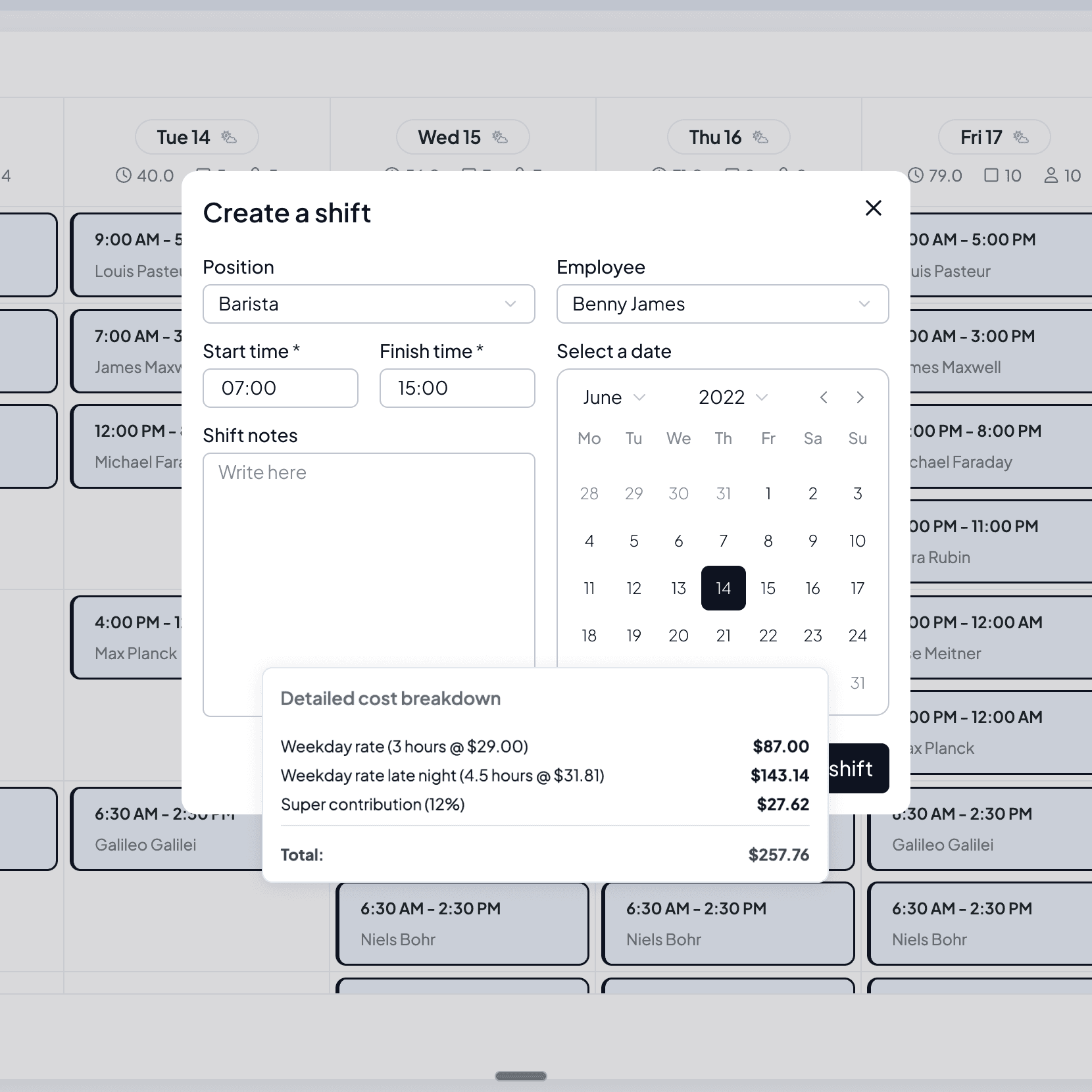
Shiftly is a calculation tool, not a payroll provider. It estimates what a shift should pay under the award you configure, shows the breakdown behind every figure, and keeps the roster, the hours and the timesheet in one place so the working is still there when somebody asks for it.
- Award based estimates for the Hospitality Industry (General) Award, the Restaurant Industry Award and the other Modern Awards you configure
- Shift cost shown as you roster, with the penalty, loading and overtime lines separated out
- Age based rates recalculated as juniors have birthdays, rather than on the day somebody remembers
- Timesheets built from the hours actually worked, with breaks captured against the shift
- Every estimate broken down, so you can check it against the award before pay day
Frequently asked questions
What actually happens first if Fair Work finds a casual was underpaid?
Usually a compliance notice, not a court. The notice has to set out how the law was breached, what you have to do to fix it, how long you have, and how to apply to a court to have it reviewed. If you do what it says by the date it sets, Fair Work cannot start civil proceedings for the breaches the notice covers. Ignoring one is the expensive route, because the penalty for not answering is separate from the back pay you owed anyway.
Does a wrong casual rate make me a criminal?
No. Intentional underpayment has been a criminal offence since 1 January 2025, but Fair Work says plainly that the offence does not cover honest mistakes. The question is whether you meant not to pay what was owed. A venue that ran on the wrong award for two years and repaid it once it found out sits a long way from one that knowingly paid under the minimum.
How far back does the back pay go?
Six years. A small claims application has to be made within 6 years of the contravention, and that process handles underpayments up to $100,000. In practice your records decide the argument: if the time and wages records are not there, the conversation stops being about what you owe and becomes about what you can prove.
My casuals work the same shifts every week. Are they still casuals?
Possibly not, and that is a separate exposure from the rate. A casual is someone whose employment has no firm advance commitment to ongoing work and who is entitled to a casual loading. A regular pattern on its own does not settle it. But a casual with at least 6 months service, or 12 months in a small business, who believes they no longer meet that definition can give you written notice to change to permanent, and you have 21 days to respond in writing and can only refuse on set grounds.
Which is worse, underpaying or overpaying a penalty rate?
Underpaying is the one that carries the penalty, but overpaying is the one venues live with for longer, because nobody reports it. Paying a Sunday at the hospitality rate when the restaurant award covers you is not a breach, it is a standing margin leak of a few dollars an hour on your busiest day. Both come from the same root cause, which is why the self check above starts with coverage rather than rates.
Does any of this apply to Shiftly On-Demand shifters?
Not in the same way. Shifters are independent contractors engaged directly by the venue, with their own ABN, so Modern Awards do not apply to them and there is no PAYG withholding. Shifts are priced at or above award minimums, plus super. Shiftly facilitates the match and moves the payment, and it is not the employer, the agency or the payroll provider.
What does Shiftly cost a venue?
The platform is free, with no per employee fee, no setup fee and no contract. The only thing Shiftly ever charges for is an On-Demand shift that actually gets filled, at 8% to the venue.
Can Shiftly tell me whether I have underpaid someone?
It can show you the numbers to compare. Shiftly is a calculation tool that estimates what a shift should pay under the award you configure, and it shows the breakdown behind every figure so you can check it. Your business stays responsible for verifying the result, and anything that looks like a real underpayment is a conversation for your accountant, an employer association or Fair Work.
What it looks like in practice
Fair Work checked 28 venues, 22 were underpaying
Inspectors walked into 28 Hobart venues unannounced. Base rates and penalty rates were what they got wrong most, which is exactly the pair a casual roster gets wrong.
Read the inspection findingsIgnoring a compliance notice cost a restaurant
A Perth operator was ordered to pay back pay it always owed, plus a much larger penalty for not answering the notice that asked for it. Three award errors triggered it.
Read what a notice costsThe hospitality award mistakes that cost the most
Six common MA000009 rostering errors, costed, including the one that is an overpayment nobody notices and a seven step check for next week's roster.
Read the six mistakesPrice the shift before you pay it
Put your roster, hours and timesheets on Shiftly and every shift arrives with the award breakdown attached, so the week you would have had to rebuild by hand is already costed.