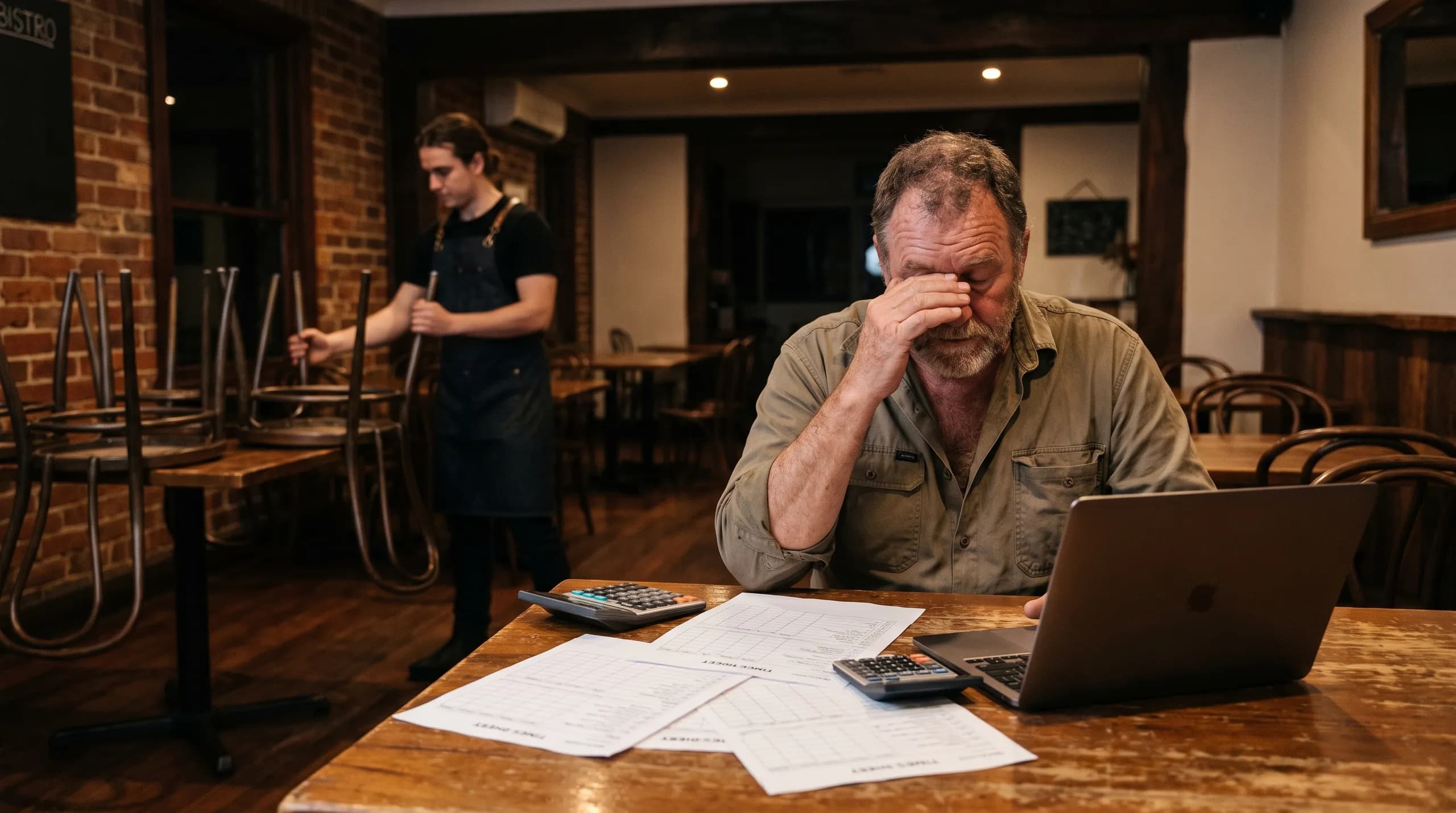
Why casual penalty rates take hours every fortnight, and the method that takes minutes

Working out casual penalty rates doesn't take hours because of the maths. It takes hours because every block of worked time needs seven decisions under the Hospitality Award, so here's the count, one Thursday close priced line by line, and the method that shrinks Sunday night to an exception list.
It's Sunday night. The fortnight's timesheets are open in one tab, the Hospitality Award in another, and there's a calculator on the phone beside the laptop. You aren't stuck on a sum. You're stuck on whether Dan spent Thursday collecting glasses or pouring beers, because one is Level 1 work and the other is Level 2, and on whether the close finished at 1am like the roster says or twenty past like the group chat implies.
That's the whole problem: the arithmetic is trivial and the assembly isn't. Every block of worked hours needs seven decisions before it has a rate, and a timesheet records none of them. Building the roster has the same shape, which is why the roster takes half of Sunday too. This is the pay side of that count.
Quick answer: under the Hospitality Industry (General) Award (MA000009), each block of worked hours needs seven decisions: level, age, liquor service, day, time of night, which penalty wins, and hours already worked. Figures are adult casual minimums from the first full pay period on or after 1 July 2026, before super. General information, not legal or financial advice: check pay against the award itself.
Seven decisions stand between a worked hour and a rate
| Decision | What it changes | Where it lives | Why it eats time |
|---|---|---|---|
| 1. What level are they on? | Base rate: $26.44 at Level 1, $27.08 at Level 2, $32.13 at Level 6 | Table 3, Schedule A | Follows duties done, not the job title |
| 2. Adult or junior rates? | 50% under 17, 60% at 17, 70% at 18, 85% at 19, full at 20 | Table 5 | Moves on a birthday, sometimes mid-fortnight |
| 3. Did a junior serve liquor? | Junior liquor service employees get the adult rate | Clause 13.5 | Turns on that shift's work, not the person |
| 4. Which day was it? | Casual 125% weekdays, 150% Saturday, 175% Sunday, 250% public holiday | Table 14 | A close past midnight is two days |
| 5. What time of night? | Plus $2.95 an hour 7pm to midnight, $4.42 midnight to 7am, Monday to Friday | Table 14 | Paid per hour or part of an hour |
| 6. Which penalty wins? | Only the highest, except a missed break penalty, paid on top | Clause 29.3 | You need to know the exception exists |
| 7. Where does the hour sit in the week? | Past 12 hours a day or 38 a week, it's overtime | Clauses 11.2, 11.4 | Depends on every earlier shift that week |
None of the seven is hard, and none of them is arithmetic. That's why a faster calculator never made the fortnight any shorter.
One Thursday close, priced line by line
A Level 2 adult casual, where most bar and floor staff sit, rostered 6pm to 1am on a Thursday with the 30 minute unpaid meal break at 8pm. Nothing unusual about it, and it still carries three rates.
| Block | Hours | Rate | Why | Line total |
|---|---|---|---|---|
| 6pm to 7pm | 1 | $33.85 | 125% of $27.08 | $33.85 |
| 7pm to 8pm, then 8.30pm to midnight | 4.5 | $36.80 | 125% plus $2.95 | $165.60 |
| Midnight to 1am | 1 | $38.27 | 125% plus $4.42 | $38.27 |
| Total | 6.5 paid | $237.72 |
Now the version where the section never emptied and the break never happened. The half hour becomes paid time at $36.80, and clause 16.6 adds 50% of the ordinary hourly rate, $13.54 an hour, from the 6 hour mark at midnight. The same roster line costs $269.66, an extra $31.94 nobody chose.
Move the identical close to Friday and the hour after midnight is a Saturday hour at $40.62, because Table 14 prices the day, not the shift. That line is $240.07. Same person, same roster line, three different totals.
Then multiply. Fourteen casuals on five shifts each is 70 shifts a fortnight, and the ones crossing 7pm or midnight split into extra blocks, so call it 100. Seven decisions on each is 700, and at twenty seconds a decision that's close to four hours, assuming you never have to look anything up.
Three things that turn seven lookups into a whole night
You rostered one shift and you're paying another
The roster said 6pm to 1am. The clock says 5.52pm to 1.18am, because the last table wouldn't leave. Those extra minutes sit in different rate blocks, and the overnight addition is paid per hour or part of an hour, so Thursday's pricing is wrong by Sunday. Rounding the clock to tidy it up quietly moves money one way, which is the story of the ghost hour.
The one penalty that stacks
Where two penalties could apply, clause 29.3(b) pays the highest and no other, so a casual at 9pm on a weekday public holiday gets 250%, not 250% plus the $2.95. Clause 29.3(c) pays the missed meal break penalty on top, and whether that applies isn't on the roster. It depends on whether someone actually got their 30 minutes, so know what a missed break costs before four turn up in one fortnight.
The staff whose level nobody wrote down
Classification follows duties, not job titles. Schedule A puts picking up glasses and wiping tables at food and beverage attendant grade 1, and dispensing liquor, taking money and waiting tables at grade 2. The glassie who spent Thursday on the bar did grade 2 work, and a decision nobody records gets re-made every fortnight. On a Saturday that's $39.66 against $40.62 an hour; our guide to the MA000009 levels settles it in ten minutes.
The method that takes minutes instead
- Write each person's classification down once. Level against the Schedule A duties, date of birth, and whether the role includes liquor service. That settles decisions one to three for good.
- Set the award at the venue, not the shift. Day rates, night additions and overtime thresholds are the same for every casual on your floor. Held in your head, they get re-decided 70 times a fortnight and drift.
- Price the roster before you publish it. A close crossing 7pm and midnight has a cost before anyone works it. See it while you can still move the shift, not on Sunday when all that's left is paying it.
- On Sunday, review the exceptions only. Not 70 shifts, just the list below, which is usually under ten lines and the only part of the fortnight that needed you.
The Sunday exception list
| Flag it when | Why it changes pay | Where to check |
|---|---|---|
| The clock disagrees with the roster across 7pm or midnight | The minutes land in a different rate block | Table 14 |
| A shift ran over 6 hours with no meal break recorded | 50% of the ordinary hourly rate is added from the 6 hour mark | Clauses 16.5, 16.6 and 29.3(c) |
| A casual passed 12 hours in a day or 38 in the week | Those hours are overtime | Clauses 11.2 and 11.4 |
| A close crossed into a Saturday, Sunday or public holiday | The hours after midnight take the new day's rate | Table 14 |
| Someone under 20 had a birthday | Their junior percentage steps up | Table 5, clause 18.4(a) |
| A junior worked liquor service | That shift takes the adult rate | Clause 13.5 |
Where Shiftly fits
Shiftly is free workforce management for Australian venues, and on the pay side its job is narrow. You set each person's level, date of birth and employment type once, and award interpretation helps estimate what every shift costs against the award rules your venue has configured, line by line, so you can check it. Clocked times flow into award-aware timesheets, so you price the hours worked, not the hours rostered.
It's a calculation tool, not a payroll provider, and your business still checks what gets paid. When the roster comes up short, the same screen sends the open shift to Shiftly's on-demand network of local hospitality workers: the roster that fills itself, free, with no per-employee fees. Get started with Shiftly.
Frequently asked questions
Why does working out penalty rates for casuals take so long every fortnight?
Because almost none of the time goes on arithmetic. Under the Hospitality Award, every block of worked hours needs seven answers before it has a rate: level, adult or junior rate, liquor service, day, time of night, which penalty wins, and hours already worked. None is stored anywhere useful, so a 70 shift fortnight comes to roughly 700 decisions.
Do penalty rates stack under the Hospitality Award?
Generally no. Clause 29.3(b) says that where more than one penalty rate would apply, you pay the highest and no other. The carve-out is clause 29.3(c): the missed meal break penalty under clause 16 is paid in addition. Table 14's casual rates already include the 25% loading, so it's never added again on top.
What does the Hospitality Award pay when a meal break is missed?
On a shift of more than 6 hours where the unpaid meal break isn't allowed, clauses 16.5 and 16.6 add 50% of the ordinary hourly rate from 6 hours after starting until the break is given or the shift ends. It's calculated on the Table 3 minimum, $27.08 at Level 2, so the extra is $13.54 an hour on top of whatever penalty rate already applies.

Co-founder of Shiftly. Milan works with hospitality businesses across Australia to make rostering, timesheets and award-based pay radically simpler.