For Australian venues pricing casual hours under MA000009
Why casual penalty rates take hours every fortnight
It takes hours because the arithmetic is not the work. Under the Hospitality Award, every worked hour needs seven decisions before it has a rate: level, age, employment type, day, time of night, which penalty wins, and hours worked so far. Shiftly holds the first three per person and applies the rest as you roster.
Free for every feature. No credit card required.
It is Sunday night. The timesheets are open in one tab, the Hospitality Award is open in another, and there is a calculator on the phone beside the laptop. You are not stuck on a sum. You have not been stuck on a sum all night. You are stuck on whether Dan was on the bar or the floor on Thursday, because one of those is a Level 1 and the other is a Level 2, and on whether Thursday's close finished at 1am like the roster says or at twenty past like the group chat implies.
That is the whole problem in one sentence: the arithmetic is trivial and the assembly is not. Every worked hour has to be resolved against seven separate things before a rate exists, and nothing on a timesheet tells you any of the seven. Building the roster has the same shape, which is why the roster takes half of Sunday too. This page counts the pay side: what the seven are, what they do to one Thursday close, and the method that turns the fortnight into a ten line review. The figures come from the Hospitality Award reference page and are quoted for an adult casual.
Rates last verified: 10 October 2026, against the Hospitality Industry (General) Award MA000009. Every dollar figure below is an adult casual minimum applying from the first full pay period on or after 1 July 2026, before super, workers compensation and payroll tax. The 8% service fee mentioned later is a Shiftly venue side rate, not a Fair Work figure. This is general information, not legal or financial advice, and your business is responsible for checking pay before it goes out.
Seven decisions stand between a worked hour and a rate
One hour, one casual, under one award. None of these is hard and none of them is arithmetic. This is the lookup tree you run before the calculator is any use at all.
| What it changes about the hour | |
|---|---|
| 1. What level are they on? | The base rate everything else is a percentage of: $26.44 at Level 1, $27.08 at Level 2, $32.13 at Level 6 |
| 2. Adult rates or junior rates? | 50% of the rate under 17, 60% at 17, 70% at 18, 85% at 19, the full rate at 20 |
| 3. Did they serve liquor that night? | Adult rate at any age, whatever the birthday says |
| 4. Which day did the hours fall on? | Casual Saturday 150%, Sunday 175%, public holiday 250% of the ordinary hourly rate |
| 5. What time of night was it? | Adds $2.95 an hour from 7pm, and $4.42 an hour from midnight, Monday to Friday |
| 6. Which penalty wins? | Only the highest applies where two overlap, with one exception that is paid on top |
| 7. Where does the hour sit in the week? | Past 12 hours in a day or 38 in the week the hour is overtime, and the loading structure changes |
One Thursday close, three different rates
An ordinary evening hour
125% of the Level 2 ordinary hourly rate, with the 25% casual loading already inside it. This is the only hour of the night that is a single lookup.
The evening loading starts
The same 125%, plus $2.95 for each hour or part of an hour of ordinary time worked between 7pm and midnight, Monday to Friday.
And the rate moves again
125% plus $4.42 an hour from midnight to 7am on a Monday to Friday. Same person, same section, same shift, third rate of the night, and the roster showed one number.
Add the break, and the same shift has two more answers
One Level 2 adult casual, rostered 6pm to 1am on a Thursday, with the 30 minute unpaid meal break taken at 8pm. Nothing unusual about it. Here is that shift priced line by line.
- 6pm to 7pm1 hour at the ordinary casual rate$33.85$33.85
- 7pm to 8pm, then 8.30pm to midnight4.5 hours at 125% plus $2.95$36.80$165.60
- Midnight to 1am1 hour at 125% plus $4.42$38.27$38.27
Now run the version where the break never happened, because the section never emptied out. The 30 minutes become paid time at $36.80, and clause 16.6 adds 50% of the ordinary hourly rate, $13.54 an hour, from the 6 hour mark at midnight until the shift ends. The same roster line is $269.66. Nobody chose the $31.94, and the roster showed neither number. Then move that identical close to a Friday and the hour after midnight stops being a Monday to Friday overnight hour and becomes a Saturday one: $40.62 rather than $38.27, because Table 14 prices the day, not the shift.
Then multiply. Take a 20 person venue running 14 casuals at five shifts each across the fortnight, and that is 70 casual shifts. Count the ones that cross 7pm or midnight and they are two or three priced blocks rather than one, so call it 100 blocks. Seven decisions on each is 700 decisions. At twenty seconds a decision that is close to four hours, and twenty seconds assumes you never once have to go and look something up.
Three things that turn seven lookups into a night
The count above assumes every answer is sitting there waiting for you. These are the three reasons it usually is not, and all three are particular to how a venue runs.
You priced the roster and you pay the timesheet
The roster said 6pm to 1am. The clock says 5.52pm to 1.18am, because the last table would not leave. Those 26 minutes do not land in one rate, they land either side of midnight, and the award pays the evening and overnight loadings per hour or part of an hour. Every clocked shift moves its own block boundaries, so the pricing you did on Thursday is the wrong pricing by Sunday.
The one penalty that stacks
Where two penalties could apply to the same hour, clause 29.3 pays the highest and no other. The exception is the break penalty: if a venue does not let someone take their unpaid meal break on a shift of more than 6 hours, clause 16.6 adds 50% of the ordinary hourly rate from the 6 hour mark, and clause 29.3(c) pays it on top of the penalty rate. Whether it applies is not on the roster. It depends on whether someone actually got their 30 minutes.
The four people whose level nobody wrote down
Classification under this award is duties, not job title. The person who pulls beers, runs the till and clears tables is a food and beverage attendant, and whether that is a Level 1 or a Level 2 is a judgement somebody made once and never recorded. So it gets re-made every fortnight, occasionally differently. On a Saturday the two are $39.66 and $40.62 an hour, which is 96 cents nobody can see and nobody can defend.
Two of those three are worth reading properly before you change anything. Rounding a 1.18am finish back to 1am is the usual fix, and on a close it is the expensive one, because those 18 minutes sit in the window the award loads at $4.42 an hour or part of an hour: the ghost hour runs that across a full roster. The break rule cuts both ways too, and the 30 minutes nobody took on a busy Saturday is the line most likely to come back at you, so it is worth knowing what a missed break actually costs before the fortnight where four of them turn up at once.
The method that takes minutes instead
It works on paper, which is the point. Nothing here needs software. What software does is stop you having to hold it.
Write the classification down once
Against the duties in Schedule A, not the job title on the roster. Record the level, the date of birth and whether the role involves serving liquor, because clause 13.5 pays an adult rate at any age for liquor service. That is decisions one, two and three settled for every shift that person ever works.
Set the award at the venue, not at the shift
The day rules, the evening and overnight loadings, the casual loading and the overtime thresholds are the same for every casual on your floor. They belong to the venue once. The moment they live in your head instead, you are re-deciding them 70 times a fortnight and they drift.
Price the roster before you publish it
A weeknight close that crosses 7pm and midnight has a cost before anyone works it, and the same close on a Friday has a different one. Seeing that number while you can still move the shift is worth more than seeing it on the Sunday after, when the only choice left is to pay it.
On Sunday, review the exceptions only
Not 70 shifts. The ones where the clock disagreed with the roster, the ones where a break was not taken, the ones where someone crossed 38 hours for the week, and the birthdays. That list is usually under ten lines, and it is the only part of the fortnight that actually needed you.
The roster that fills itself
Where Shiftly fits
Shiftly is free workforce management for Australian venues, with an on-demand staffing marketplace built into the same roster. On the pay side its job is narrow and useful: settle the seven decisions once, apply them to every shift as you build it, and leave you reviewing the exceptions rather than rebuilding the fortnight.
- Set each person's classification level, date of birth and employment basis once, and Shiftly carries them into every shift instead of asking you again
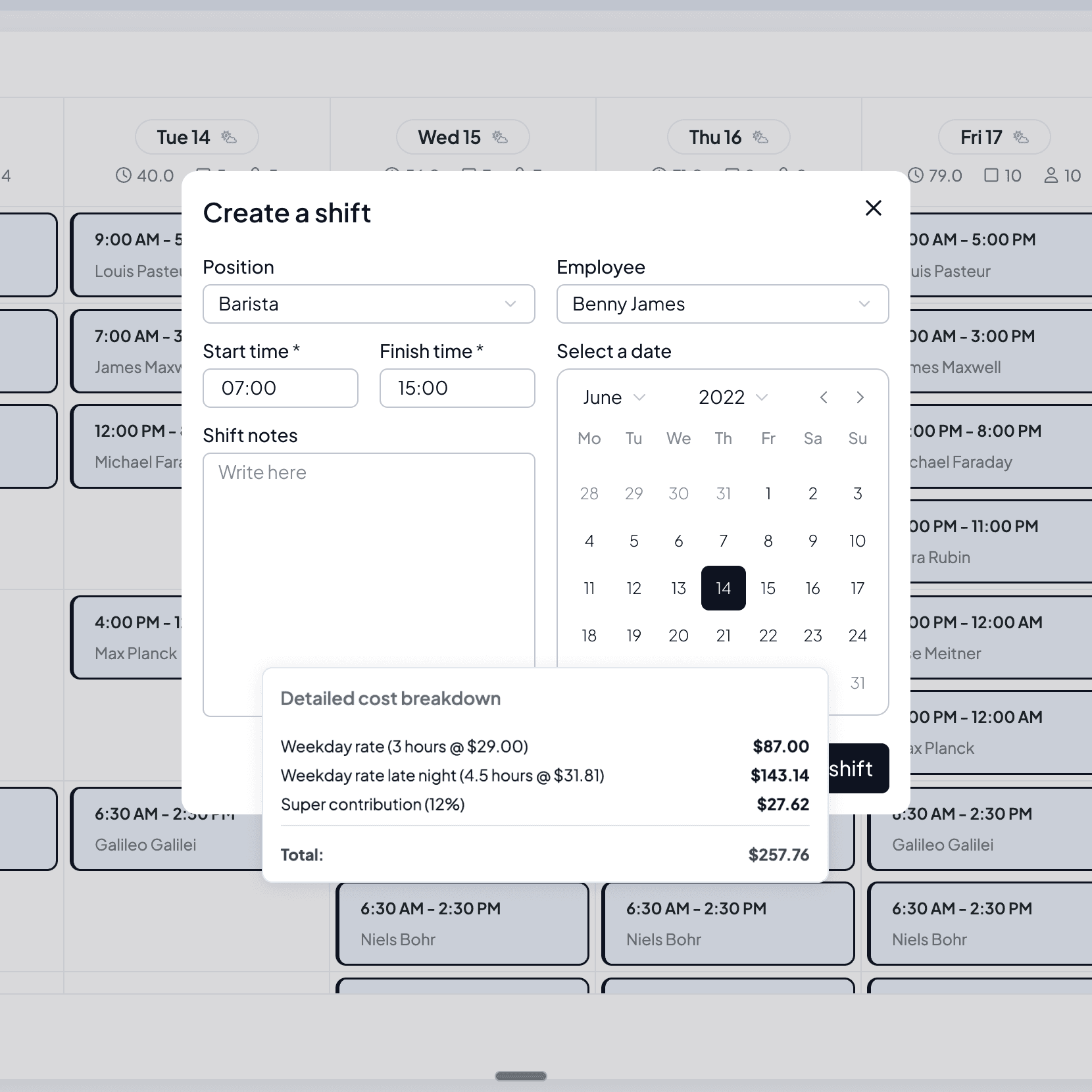
- A calculation tool that helps estimate what a shift costs against the award rules your venue has configured, with the breakdown shown line by line so your business can check it before anyone is paid
- Clocked start and finish times flow into the timesheet, so the hours being priced are the hours worked rather than the hours rostered
- Rostering, availability, timesheets and award pay tools are free for any number of staff or venues, with no per employee fee
- When the roster still comes up short, the same screen will open the shift to Shiftly On-Demand (coming soon, starting in Sydney), where a filled shift carries an 8% service fee to the venue and nothing at all in a fortnight you never post one
Frequently asked questions
Why does working out award and penalty rates for casuals take so long every fortnight?
Because almost none of the time goes on arithmetic. Under the Hospitality Award a single worked hour needs seven separate answers before a rate exists: the classification level, whether adult or junior rates apply, whether the person served liquor, which day the hour fell on, what time of night it was, which penalty wins where two overlap, and how many hours that person had already worked. Each answer is easy on its own and none of them is stored anywhere useful, so you look all seven up again for the next hour.
How many different rates can one casual shift carry?
More than most rosters show. A Level 2 adult casual working a Thursday 6pm to 1am is paid $33.85 an hour until 7pm, $36.80 from 7pm to midnight because Table 14 adds $2.95 an hour for ordinary hours in that window, and $38.27 after midnight because the addition becomes $4.42. That is three rates in one shift before you consider breaks. Move the identical shift to Friday and the hour after midnight is a Saturday hour at $40.62 instead, because the award prices the day rather than the shift.
Do penalty rates stack under the Hospitality Award?
Generally no. Clause 29.3 says that where more than one penalty rate could apply to the same hour, the employer pays the highest applicable penalty rate and no other. There is one carve out in clause 29.3(c): the break penalty is paid in addition. So a casual working 9pm on a Saturday is paid the Saturday rate rather than the Saturday rate plus the evening loading, but a missed meal break is added on top of whatever the highest penalty was.
What does the Hospitality Award pay when a meal break is missed?
On a shift of more than 6 hours, clause 16.5 and clause 16.6 require the employer to pay an extra 50% of the employee's ordinary hourly rate from 6 hours after the shift started until the break is given or the shift ends. Ordinary hourly rate here means the minimum hourly rate for the classification, $27.08 at Level 2 rather than the casual loaded figure, so the addition is $13.54 an hour on top of whatever penalty rate those hours were already carrying. It is the clearest example of a cost that exists in the timesheet and nowhere in the roster.
Why does the timesheet disagree with the roster on pay?
Because the roster holds intended times and the timesheet holds worked ones, and the award prices the second. A shift rostered 6pm to 1am but clocked 5.52pm to 1.18am is not the same shift: the evening and overnight loadings in Table 14 are payable per hour or part of an hour, the extra minutes sit either side of midnight, and a break that was skipped changes the rate for the back half of the shift. Rounding the clock to tidy that up quietly moves money in one direction, which is a separate problem worth knowing about.
Can Shiftly work out casual penalty rates for me?
Shiftly is a calculation tool designed to assist with payroll, not a payroll provider, accountant or legal adviser. It applies the award rules and rates your business has configured to the hours recorded against each shift, and shows the breakdown behind every estimate so you can check it. Businesses are responsible for verifying rates and confirming what gets paid. The award pay tools are part of the free plan, with no per employee fee.