For venues rostering working holiday staff
Your working holiday staff will leave mid season
Working holiday staff leave on a date you can see coming, and most venues still treat it as a surprise. The ones that handle it well run it as a capacity problem: they record each visa end date, keep a bench of RSA-cleared casuals who already know the floor, and, once Shiftly On-Demand opens in Sydney, use it to fill what the bench cannot.
Free for every venue. No per employee fee, no credit card, no contract.
The exit has a date on it, from day one
The stay is 12 months, from the start
A working holiday visa lets the holder work for the full duration of a 12 month stay, so the last week they can put on an apron is knowable in the week they first put one on.
The qualifying work is mostly not yours
Second Working Holiday visas granted in 2024-25 naming agriculture, forestry or fishing as the employer industry. Accommodation and food services accounted for 10,014.
Nearly half named no industry at all
Share of second Working Holiday visa grants in 2024-25 nominating no industry, which Home Affairs puts down to the UK free trade agreement removing the specified work requirement.
The largest group has no 88 days
United Kingdom citizens as a share of subclass 417 holders in Australia at 30 June 2025, 50,006 of 164,620. They have been exempt from specified work since 1 July 2024.
Four ways the February gap gets covered
Same missing bartender, four routes. What separates them for a venue is how fast the Friday fills, what the fill costs on the shift itself, and whether you know who is walking through the door.
| Shiftly On-Demand (coming soon) | |
|---|---|
| Time from gap to covered | Minutes, from inside the roster |
| What the venue pays on the fill | 8% of the filled shift |
| Who engages the worker | Your venue, direct |
| Qualifications visible before you accept | On the shifter's profile |
| Where it happens | The roster you already run |
| What it leaves behind | A rating, both ways |
What one February Saturday costs to cover
One food and beverage attendant, grade 2, eight hours on a Saturday night in February, after the summer crowd and the summer staff have both gone home. The wage line does not move. Everything around it does.
- The shiftEight hours on a Saturday night, one casual food and beverage attendant grade 2, a Level 2 classification under the Hospitality Award.
- Wages on the roster$40.62 an hour on a Saturday, so $324.96 for the shift, plus super. That line is the same whoever works it.
- Filled from your own benchNo fee at all. The whole cost is the wages, and the person already knows which taps run slow and where the spare glassware lives.
- Filled through a labour hire agencyAbout 22% on top of the fill, roughly $71 on a shift this size, and you meet them when they walk through the door.
- Filled through Shiftly On-Demand (coming soon)8% to the venue, about $26 on a shift this size, and the profile, the qualifications and the rating are in front of you before you accept.
- Not filledNothing on the wage line. The cost lands on the five people who did turn up, on the tables that waited, and on the next roster those five are asked to cover.
Rates last verified 10 October 2026, from the Fair Work Ombudsman pay guide for the Hospitality Industry (General) Award [MA000009], published 24 June 2026 and applying from the first full pay period starting on or after 1 July 2026. Visa figures are from the Department of Home Affairs Working Holiday Maker visa program report (BR0110) at 30 June 2025. The agency markup is the published venue-side rate for labour hire, checked July 2026. Shiftly gives you calculation tools to help estimate pay against the award, and your business stays responsible for checking the result. This is general information, not legal, migration or financial advice.
How a venue builds the bench
Not a bigger roster. A short list of people who are already onboarded, already cleared for the role and already used to your floor, kept warm through the months you know are coming.
Write the leaving date down
Ask for the visa end date when they start, and keep it beside the roster rather than in a drawer. Twelve months is a generous warning, and it only helps if somebody wrote it where they will look in November.
Count shifts, not heads
Three people leaving on 15 hours each is 45 hours a week, and it will not be spread evenly across the week. It is the Friday and Saturday night pair, the two shifts that are hardest to refill.
Onboard while you are already busy
Bring on two or three extra casuals in December, when the floor is full and a senior is on every shift anyway. An RSA, a food handling induction and a first shift next to an experienced hand cost far less in December than in February.
Keep the bench warm
Someone who has not worked in six weeks is not a bench, they are a phone number. Offer open shifts to that group first, keep their availability current, and rotate them through a shift a fortnight so they stay current on your floor.
Free platform
Keep the bench warm inside the roster
A bench is only a bench while the people on it are reachable and current. Every item below is part of the free platform, whether you ever use On-Demand or not.
- Availability from the staff app, so you know who can take a Friday before you ask
- Open shifts pushed to the staff assigned to the role, instead of a group chat nobody reads
- Shift swaps handled between staff, with the roster and the timesheet updating on approval
- Onboarding that captures a new casual's details before their first shift, not after it
- Award based pay tools that estimate what an extra Saturday adds before you publish
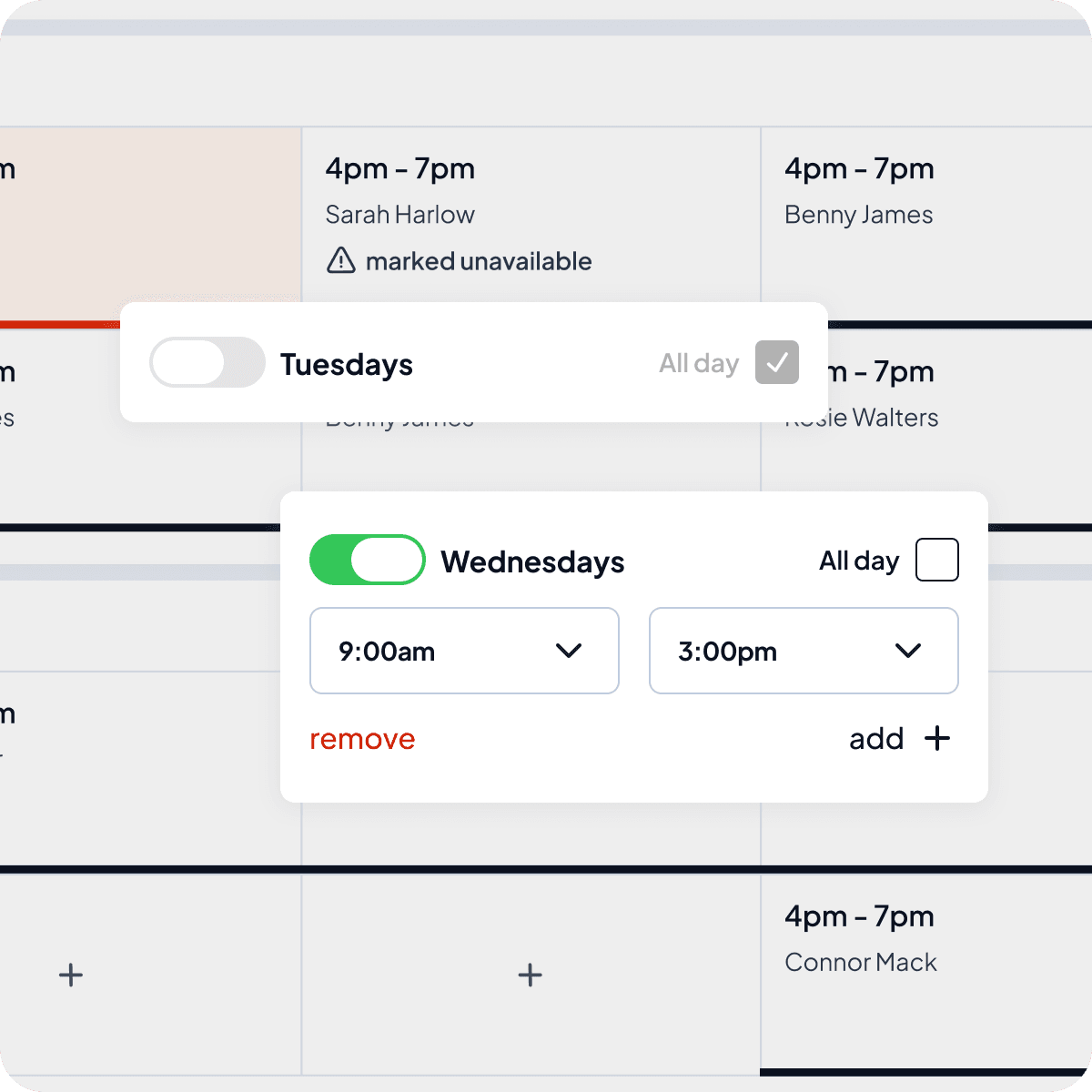
Fill what the bench cannot cover
Three people short on the same Saturday is not a rostering problem, it is a capacity problem. Shiftly On-Demand will let you fill that shift from a pool of hospitality shifters, inside the roster you already run.
Your venue engages the shifter
Shifters are independent contractors engaged directly by your venue, with their own ABN. Shiftly facilitates the match and moves the payment, and it is not the employer, the agency or the payroll provider.
Frequently asked questions
When do working holiday staff actually leave a venue?
There is no single date, which is why it feels sudden. A working holiday visa allows a 12 month stay and most people arrive for the Australian summer, so the leaving dates cluster in the weeks after it. On top of that, anyone chasing a second visa has to fit their specified work in before the first one runs out, and that work is usually regional and usually not hospitality. Ask for the end date at onboarding and the cluster stops being a surprise.
Do working holiday staff have to leave after six months with us?
Not in hospitality. Visa condition 8547 normally caps a working holiday maker at six months with one employer, but work in tourism and hospitality anywhere in Australia sits inside an exemption, so nobody has to ask permission to stay on at your venue. When someone goes, it is the visa running out or the second visa being chased, not the six month rule.
Does working in my venue count towards their 88 days?
Usually not, and that is what pulls people out of city venues mid season. Specified work for a second Working Holiday visa is tied to particular industries and regions, and in 2024-25 agriculture, forestry and fishing was named on 20,074 second visa grants against 10,014 for accommodation and food services. The exception worth knowing is that United Kingdom passport holders who applied on or after 1 July 2024 do not have to do specified work at all, and they are the largest single group in the country.
How deep should the bench be?
Work it in shifts rather than people. Add up the weekly hours held by staff whose visa ends inside six months, then look at which shifts those hours sit on. A venue losing 45 hours a week concentrated on Friday and Saturday nights needs roughly three extra casuals cleared for those shifts and used to the floor, not one new full timer.
Is Shiftly On-Demand available to my venue now?
It is rolling out, starting in Sydney. The rostering, availability, timesheets and award pay tools are free and available today, so the sensible order is to get your team and your roster onto Shiftly now and have On-Demand switched on when it reaches your area. Fully onboarded venues get first access to the pool.
What does Shiftly cost a venue?
The platform is free, with no per employee fee, no setup fee and no contract. The only thing Shiftly ever charges for is an On-Demand shift that actually gets filled, at 8% to the venue.
More on staffing a venue
Your December staffing plan
Three NSW public holidays in four days, a function season compressed into three weekends, and the maths on adding a casual instead of stretching the one you have.
Read the December planRostering student and working holiday staff
The 48 hour fortnight, the checks that sit on the venue rather than the worker, and the six month exemption most operators do not know hospitality has.
Read the rostering rulesWhy your casuals stop picking up shifts
Casuals rarely resign. They take one shift instead of three, then stop answering, and nobody counts it as turnover until the roster will not fill.
Read the retention mathsBuild the bench before February
Get your roster, availability and timesheets onto Shiftly while the floor is still full, and have On-Demand ready for the weekends the bench cannot cover.