Onboarding a pick-up-a-shift worker in 15 minutes: the induction checklist for a venue's first on-demand booking
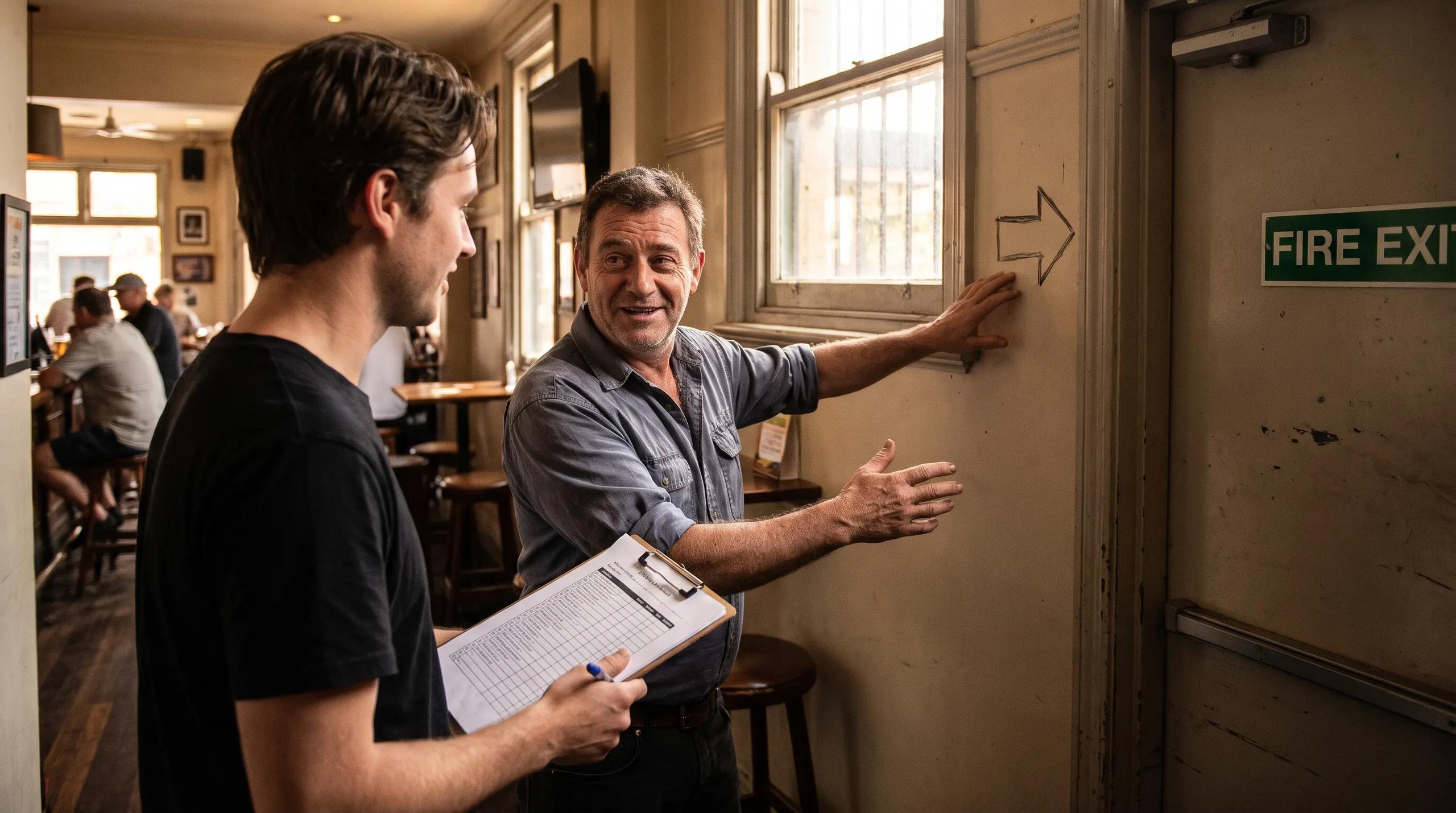
Your first on-demand worker has never seen your floor, your till or your fire exits. Here's a printable 15-minute induction checklist covering the RSA sighting, exits, till, menu and handover, and what those minutes cost.
Your first on-demand worker arrives at 5:45pm on a Saturday for a 6pm service, and the only person who can brief them is changing a keg. They've never seen your floor, your till or your fire exits. Fifteen minutes fixes most of that, and at $40 an hour those minutes cost about $12.
Most induction templates assume a new employee and a quiet Tuesday. Once you've worked out how to cover the gap, you need something built for a person you may only see once, on your busiest night.
The short version: book the shift to start 15 minutes before you need them on the floor. Sight the RSA at the door, walk the exits, then cover till, menu and handover in that order. Calling someone a contractor doesn't shrink your safety duties. This suits bar and floor work only. General information, not legal advice.
A contractor on your floor is still your safety duty
A venue engages an on-demand worker as an independent contractor for the shift, and plenty of managers assume that makes safety someone else's job. It doesn't. The model WHS laws, in place everywhere except Victoria with some local variations, cover people who carry out work in any capacity for a business, contractors included. Victoria runs its own OHS Act, and WorkSafe says employers owe contractors the same duty on matters the employer has, or should have, control over.
Two model regulations set the bar. Regulation 39 says instruction must be "suitable and adequate" for the work and "readily understandable" by the person getting it. Regulation 43 requires an emergency plan, including instruction to relevant workers on carrying it out. That second phrase in regulation 39 is the one to act on: someone three weeks off the plane will nod at a spoken list of exits and keep none of it. Walk it, then make them walk it back.
What the 15 minutes actually costs
You pay for the hours worked on an on-demand booking, so put the brief inside the booked time instead of asking someone to turn up early for nothing. Here's one quarter-hour on that Saturday.
| Item | Working | Cost |
|---|---|---|
| Worker's pay | 15 minutes at $40 an hour | $10.00 |
| Super at 12% | 12% of $10 | $1.20 |
| 8% service fee plus GST | $0.80 + $0.08 | $0.88 |
| Your supervisor's time | 15 minutes at $44.18 (casual Level 4, Saturday) | $11.05 |
| Total | Per brief | $23.13 |
Treat that as an illustration. The $40 is the rate in Shiftly's published pricing example, and your rate will differ. The supervisor figure is before on-costs. If the worker is registered for GST, GST on their pay is added. The $1.10 super processing fee is charged per shift, so the brief doesn't change it.
An induction costs about $23. One unchecked RSA can cost a NSW licensee a $1,100 fine.
Send this before they arrive
The Fair Work Ombudsman's own induction template starts before day one: tell the person where, when and who to report to, and what to bring. (If you're hiring an employee rather than booking a contractor, the paperwork is a different list.) Two minutes of typing buys back the first five minutes at the door.
- Where: which door, any code, and where to park or get dropped off.
- Who: one first name to ask for, and a number if the door is locked.
- When: the start time, stated as including a 15-minute brief.
- Bring: the RSA card or certificate, plus what to wear and whether you supply the apron.
The 15-minute checklist (print this)
Print it, tape it inside the office door and run it with a clock. The right-hand column matters most, because "any questions?" proves nothing and a small demonstration does.
| Minute | Do this | Ticked when |
|---|---|---|
| 0 to 2 | RSA and ID. Sight the card, digital card or interim certificate. Match the name and photo, check the date. | Name, photo and date all line up |
| 2 to 5 | Exits and emergencies. Walk each exit and the assembly point. Show the extinguishers and first aid kit. Name tonight's first aider and who runs an evacuation. | They lead you back to the nearest exit |
| 5 to 6 | Hazards and no-go zones. Wet floors, stairs, glass, hot surfaces. Cellar, kegs, slicer and fryer are off limits tonight. | They can name what not to touch |
| 6 to 9 | Till. Their own login. Open a tab, split a bill, take a card. Who can void or refund. | They ring up a drink and get a void approved |
| 9 to 12 | Menu and allergens. Tonight's specials, what has run out, where the allergen sheet lives. The rule: never guess. | They find the allergen sheet unprompted |
| 12 to 13 | Service rules. ID policy, drink limits, who cuts someone off and who backs them up. | They know who to fetch |
| 13 to 15 | Handover. Section, buddy, break time, finish time, how to clock on and off, who to tell about an injury or harassment. | They can repeat the buddy's name and break time |
| Sign-off | Worker's name, date, RSA sighted, brief given by. | Kept with the night's paperwork |
Four lines that need more than a tick
A profile upload is not a sighting. A platform can show you the ticket a worker uploaded, but the fine lands on the licensee. In NSW, the on-the-spot fine outside a prescribed precinct is $220 for a staff member serving without a current RSA, and $1,100 for the licensee who permits it. A digital card is legally valid, and an interim certificate covers 90 days.
The NSW Regulation defines a staff member as any "employee or agent" of the licensee or person purporting to act for them, which is wide enough to take in a contractor pouring your beer. Queensland gives 30 days from starting employment and Victoria a month from first supplying alcohol, but don't plan a one-night booking around a grace period. Ask for the document, and remember that an RSA from another state can depend on which paper they kept.
- Till: give them a login and keep them off the cash-up. A login puts a name on every sale. A stranger counting the drawer at 1am invites an argument, and even with employees a shortfall is very hard to recover from pay.
- Menu: the rule is don't guess. Food with no label, such as a plate from your kitchen, still needs its allergens displayed or given to the customer on request. Your new starter is the person they'll ask, so give them one route: the sheet or the kitchen.
- Service: say who backs the call. In NSW, the ban on supplying an intoxicated person reaches a licensee or "an employee or agent". A one-shift worker won't cut off your regular unless you've told them it's their call and who will walk over.
- Handover: one name, not five. Introduce the buddy in person. "Ask anyone" means nobody, and a new face won't know who to tell when a customer crosses a line.
Where 15 minutes isn't enough
The regulation 39 test moves with the work, so a bigger job needs a bigger brief. The simpler fix on a first booking is to shrink the job.
- Food prep. In category one and two food businesses, anyone handling unpackaged, potentially hazardous, ready-to-eat food needs a food safety course or adequate skills before they start.
- Gaming machines. Liquor & Gaming NSW makes RCG training mandatory for all staff working with them. Extra tickets are worth asking about up front.
- Cellar, kegs, slicers and fryers. Keep a first-timer off these unless you've set aside proper time to train them.
- Closing alone. Keys, alarms and cash-up stay with someone who knows the building.
Let the booking do half the briefing
Shiftly is free rostering and award-aware timesheets with an on-demand staffing network built in, the roster that fills itself, available along the east coast of Australia. Workers see the venue, role, hours, what to wear and who to ask for before they accept, and you see their uploaded tickets and shift history before you book. The venue engages the worker as an independent contractor for the shift, and Shiftly facilitates the booking and the payment. You still run the 15 minutes, because nobody else knows where your exits are. Get started with Shiftly.
Frequently asked questions
Does an experienced agency or temp worker still need an induction?
Yes. Ten years behind a bar doesn't tell them where your exits are, and an agency sending them doesn't take the duty off you: Safe Work Australia says that where more than one business owes a duty, each one keeps responsibility. For a returning worker you can cut the till and menu down to what's changed.
Who pays for the induction time?
On an on-demand booking the venue pays for the hours worked, so include the brief in the booked hours. If the person is your own employee, treat the induction as paid work too.
Do you need a signed induction record?
Model regulations 39 and 43 don't prescribe a form. A dated sheet with the worker's name and the briefer's initials is still the simplest way to show the brief happened, and it costs nothing to keep.

Co-founder of Shiftly. Milan works with hospitality businesses across Australia to make rostering, timesheets and award-based pay radically simpler.